Does irrigation affect onion bacterial bulb rot?
Yes!
Splashing irrigation water can move plant pathogenic bacteria from soil into the necks of onion plants, water on leaves and in the neck creates conditions conducive for bacterial growth, and prolonged irrigation can slow drying of leaves and the neck of onion plants during natural senescence (field curing), which leaves this senescing tissue more susceptible to bacteria.
Here’s how you can manage irrigation to reduce the risk of bacterial bulb rot:
- Don’t get the tops wet if you can help it! The single most impactful thing you can do to avoid bacterial diseases is to avoid sprinkler irrigation (center pivots, hand line sprinklers, etc.). Irrigation methods that don’t wet the foliage, such as drip irrigation, dramatically reduce the occurrence of bacterial bulb rot in arid, semi-arid, or Mediterranean climates1,2. This is less effective in production environments where rain is common during the growing season3,4,5, and even in drier environments, the costs and logistics of switching to drip irrigation must be considered carefully.
- Stop irrigating early enough! When growing onions under sprinkler irrigation, it is essential not to keep irrigating too long at the end of the season as this is the period when onions are most susceptible to infection and disease development – the leaves and necks lose defenses as the tissues start senescing, but the tops aren’t fully dried yet. Terminating irrigation at the first sign of “tops down” (5–10%) can decrease the occurrence of bacterial bulb rot relative to terminating irrigation at 90% tops down, and does not appear to decrease marketable yield6. For producers concerned about cutting off irrigation too early, there is evidence that reducing the frequency of irrigation at the end of the season can reduce the occurrence of bacterial bulb rot7. There is less research evidence that modifying the frequency of irrigation throughout the season provides benefits for control of bacterial bulb rot, but there can be a benefit to reducing irrigation frequency if growers are irrigating in excess of onion crop demand6.
For more resources on irrigation and bacterial bulb rot, see this article from Onion World and the irrigation section of this article in Crops & Soils Magazine.
Select research trial results from the Stop the Rot Project on irrigation management:
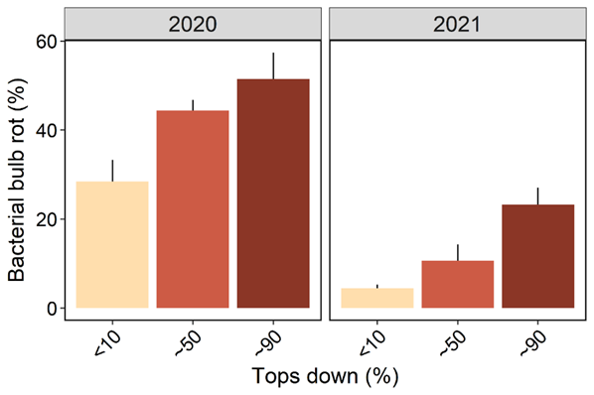
Figure 1: Total incidence of bacterial bulb rot (at harvest + after five months in storage) for the cultivar Calibra grown in the Columbia Basin of Washington State and subjected to one of three timings of the final irrigation: early (irrigation stopped at 5–10% tops down), standard (irrigation stopped one week later, at approximately 50% tops down), or late (irrigation stopped two weeks after the early treatment, at approximately 90% tops down) in 2020 (left) and 2021 (right). Local strains of Burkholderia gladioli pv. alliicola (causal agent of slippery skin) and Pantoea agglomerans (causal agent of center rot and bacterial leaf blight) were applied to onions at approximately 5 and 50% tops down to increase bacterial disease pressure (Belo et al. 2023).
| Treatment | Total bulb yield at harvest (tons/acre) | Bulb rot incidence at harvest (%) | Estimated marketable yield (tons/acre) |
|---|---|---|---|
| Solid-set sprinkler irrigation | 51.7 ± 1.3 | 15.0 ± 2.7 | 13.9 |
| Drip irrigation | 58.4 ± 0.5 | 0.5 ± 0.2 | 58.1 |
| p-value | 0.005 | 0.003 | NA* |
Table 1: The influence of irrigation method on yield and bacterial bulb rot across years for the onion cultivar Vaquero grown in Tulelake, CA in 2021 and 2022 (Wilson et al. 2024).
*Estimated marketable yield at harvest calculated from total bulb yield at harvest and bulb rot incidence at harvest. It does not account for differences in bulb size between marketable and unmarketable bulbs, and there is no probability (p-value) associated with this metric.
Authors
Gabriel LaHue, Timothy Waters, and Lindsey du Toit, Washington State University; Rob Wilson and Brenna Aegerter, University of California; Bhabesh Dutta, University of Georgia.
Recommended format for citing this document: LaHue, G. T., Waters, T. D., du Toit, L. J., Wilson, R., Aegerter, B., and Dutta, B. 2025. Frequently asked question: Does irrigation affect onion bacterial bulb rot? https://alliumnet.com/frequently-asked-questions/
This work is supported by Specialty Crops Research Initiative project 2022-51181-30013 (Stop the rot: Combating onion bacterial diseases with pathogenomic tools and enhanced management strategies) from the USDA National Institute of Food and Agriculture. Opinions, findings, conclusions, or recommendations in this publication are those of the authors and should not be construed to represent any official USDA or U.S. Government determination or policy.

Citations:
1 Wilson R., Aegerter B., and LaHue, G. T. 2024. The influence of sprinkler and drip irrigation on the incidence and severity of bacterial disease in onions grown in northeast California. Plant Health Progress 25:293–298. https://doi.org/10.1094/PHP-01-24-0002-RS
2 Teviotdale, B. L., Davis, R. M., Guerard, J. P., and Harper, D. H. 1989. Effect of irrigation management on sour skin of onion. Plant Disease 73(10): 819–822. https://doi.org/10.1094/PD-73-0819
3 Chorolque, A., Ardizzi, C. P., Pellejero, G., Aschkar, G., Navarro, F. J. G., and Ballesta, R. J. 2018. Incidence of bacterial diseases associated with irrigation methods on onions (Allium cepa). Journal of the Science of Food and Agriculture 98(14):5534–5540. https://doi.org/10.1002/jsfa.9101
4 da Silva, A., de Jesus, H., and Dutta, B. 2021. Effects of irrigation method, nitrogen rate, and fertilizer application timing on bacterial diseases in Vidalia onion, Georgia 2020. Plant Disease Management Reports 15:V012.
5 Gitaitis, R. D., Walcott, R. R., Sanders, H. F., Zolobowska, L., and Díaz-Pérez, J. C. 2004. Effects of mulch and irrigation system on sweet onion. II. The epidemiology of center rot. Journal of the American Society for Horticultural Science 129(2):225–230. https://doi.org/10.21273/JASHS.129.2.0225
6 Belo, T. R., du Toit, L. J., Waters, T. D., Derie, M. L., Schacht, B., and LaHue, G. T. 2023. Reducing the risk of onion bacterial diseases through managing irrigation frequency and final irrigation timing. Agricultural Water Management 288:108476. https://doi.org/10.1016/j.agwat.2023.108476
7 Thapa, S., du Toit, L. J., Waters, T. D., Derie, M. L., Schacht, B., and LaHue, G T. Effects of irrigation frequency on onion bacterial bulb rot in the Columbia Basin of Washington State, 2023-24. Plant Disease Management Reports 18:CF075.